Human infrastructure
Preparedness also depends on how people interpret risk, make decisions, communicate uncertainty and maintain trust.
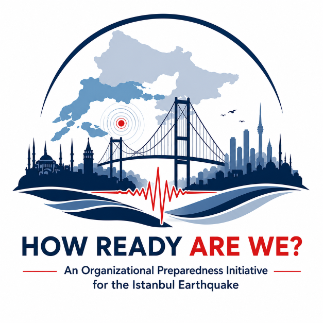 How Ready
Building Trauma-Aware Organizations in the Context of Istanbul Earthquake Risk and Organizational Preparedness
A 24-month mixed-methods research project examining how chronic earthquake risk across the Marmara Region shapes organizational decisions, employee psychosocial safety and business continuity.
Preparedness is more than physical infrastructure; leadership, trust, communication and decision quality also matter.
Chronic threat can normalize risk and delay critical preparedness decisions. Major earthquake risk in Istanbul can also create regional consequences through supply chains and Organized Industrial Zones.
Better decisions under threat; more resilient organizations before crisis.
The research examines risk assessment, preparedness decisions, employee safety, leadership practices and business continuity together.
Preparedness also depends on how people interpret risk, make decisions, communicate uncertainty and maintain trust.
Organizational recovery capacity is shaped before a crisis through leadership choices, psychosocial risk management, ethical communication and continuity planning.
Major earthquake risk in Istanbul can create regional consequences through supply chains and Organized Industrial Zones.
Institutional experience helps turn research findings into practical tools and realistic policy recommendations.
Istanbul, Edirne, Kırklareli, Tekirdağ, Çanakkale, Kocaeli, Yalova, Sakarya, Bilecik, Bursa and Balıkesir.
Running from May 2026 to April 2028, the project connects qualitative findings with quantitative research and the development of practical tools.
Understanding regional and institutional experience through in-depth interviews with development agencies, OIZs and firms, and mapping organizational risk areas.
Conducting large-scale research based on qualitative findings and academic literature, and developing and scientifically evaluating the Organizational Trauma Risk Scale.
Developing training modules and practical tools for employees, HR professionals and leaders, and conducting pilot applications in selected firms.
An organizational resilience toolkit, comprehensive findings and policy recommendations, practice-oriented guidance and academic outputs.
The knowledge produced will be translated into tools that organizations and decision-makers can use.
A risk scale adapted to the earthquake preparedness context and scientifically evaluated.
↗Qualitative and quantitative findings that make organizational risk and preparedness visible across the region.
↗Content for employees, HR professionals and leaders, followed by pilot applications in selected firms.
↗Practice-oriented tools for HR professionals and organizational leaders.
↗Policy recommendations and practice-oriented outputs grounded in the research findings.
↗Sharing research findings through academic publications and dissemination activities.
↗Choose the most relevant next step for your organization in the Marmara Region. The project team can provide official participation and information documents upon request.
iletisim@dayanikli.org ↗Qualitative interviews are individual and semi-structured, last approximately 45–60 minutes, and may take place in person or on a secure online platform. Participation is voluntary. Audio is recorded only with separate consent; participants may skip questions or withdraw at any time. Organizational names, trade secrets, legally confidential information and personal traumatic experiences will not be requested.
Circulating the invitation to suitable managers and specialists; coordinating a private space for an in-person interview; and completing the required institutional permission process.
Institutions are not asked to select or direct participants, track participation or responses, or provide personnel, health or performance records, trade secrets or internal documents.
The project brings together research leadership, field coordination and stakeholder engagement through collaboration among Columbia University, the Türkiye research team and Columbia Global Center Istanbul.
Research leadership; academic and methodological contribution; research design; scale development; and scientific evaluation.
Türkiye field coordination, institutional stakeholder communication, data collection, local context and implementation development.
Program connection, facilitation, stakeholder access and dissemination support.
Teachers College, Columbia University
Preparedness & Recovery Institute; Columbia Mailman School of Public Health
Bahçeşehir University; PRISMA Institute; IOCP
Demiroğlu Bilim University; PRISMA Institute; IOCP
PRISMA Institute
How Ready Are We? Project
IOCP
IOCP
PRISMA Institute
This project is supported through the Columbia Global–Turkish Philanthropy Funds Resilience Initiative.